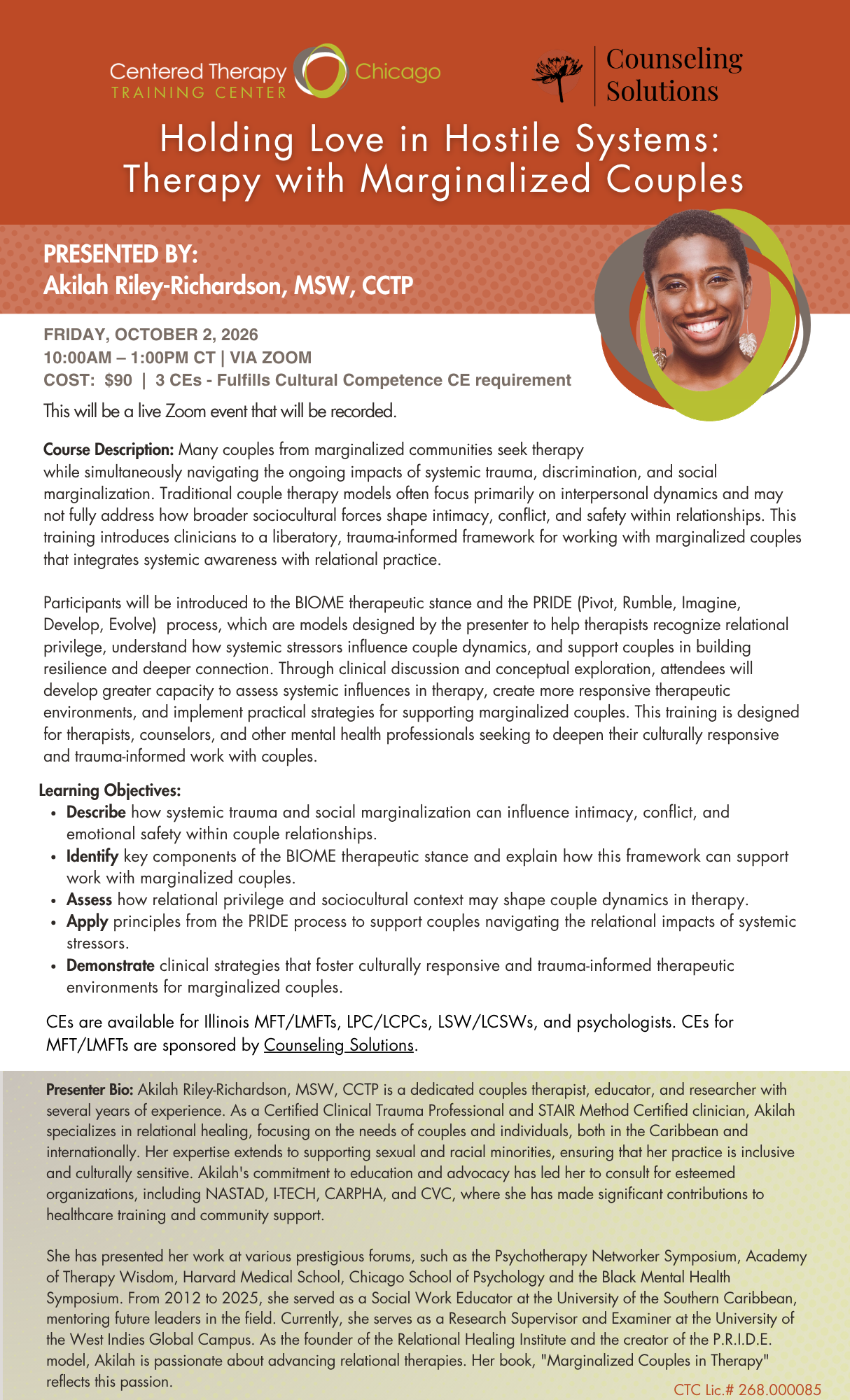
Holding Love in Hostile Systems: Therapy with Marginalized Couples Friday, October 2, 2026
Centered Therapy Chicago and Counseling Solutions are pleased to co-sponsor an upcoming virtual training: Holding Love in Hostile Systems: Therapy with Marginalized Couples, presented by Akilah Riley Richardson, MSW, CCTP.
While focused on couples therapy, this training is relevant for therapists working with both couples and individuals who want to better understand the impact of marginalization on connection, conflict, and healing.
You already know something isn’t being said in the room.
You’re sitting with a couple. One partner just flinched at something that, on paper, sounds small. But you can feel it’s not small. There’s a whole world of context underneath it — a world shaped by racism, homophobia, transphobia, immigration status, religious rejection, or the daily grind of just trying to exist safely as who they are.
And your training didn’t fully prepare you for that world.
Most couples therapy models were built around a version of “conflict” and “connection” that assumes both partners are moving through a neutral, safe environment. But for marginalized couples, there is no neutral environment. The system itself is a third presence in the room — showing up as hypervigilance, as exhaustion, as a partner who shuts down not because they don’t love their partner, but because they’ve had to armor up just to get through the day.
If you’ve ever felt like your usual tools weren’t quite reaching what was actually happening between two people, this training is for you.
What you’ll walk away with
This isn’t a theory-only training. You’ll leave with a working framework you can bring into session on Monday morning:
- The BIOME therapeutic stance — a way of orienting yourself as a clinician so you can recognize relational privilege and see how systemic stress is already living inside the room, even when no one names it.
- The PRIDE process (Pivot, Rumble, Imagine, Develop, Evolve) — a concrete, step-by-step approach for helping couples move from surviving hostile systems together to actually building resilience and closeness because of what they’ve been through, not despite it.
- Practical strategies for assessing the systemic forces shaping a couple’s intimacy, conflict, and emotional safety — so you’re treating the whole picture, not just the interpersonal surface.
- A more responsive therapeutic environment — one where marginalized clients feel like their full context is welcome in the room, not something they have to translate or minimize for you.
Why this matters, no matter who’s on your caseload
Maybe you’re not sure this applies to you. Maybe most of your caseload is individuals, not couples. Here’s the thing: even individual clients are shaped by the same invisible dynamics this training addresses — the vigilance, the code-switching, the weight of navigating relationships (romantic, familial, professional) inside systems that were never built with them in mind. Learning to see these dynamics with a couple sharpens your eye for seeing them everywhere else, too.
Led by someone who’s done the work
Akilah Riley-Richardson, MSW, CCTP is a couples therapist, educator, and researcher whose work centers relational healing for couples and individuals across the Caribbean and internationally, with particular depth in supporting sexual and racial minorities. She’s a Certified Clinical Trauma Professional and STAIR Method Certified clinician, the founder of the Relational Healing Institute, and creator of the P.R.I.D.E. model. Her book, Marginalized Couples in Therapy, and her teaching at places like Harvard Medical School, the Psychotherapy Networker Symposium, and the Black Mental Health Symposium reflect a career built around one throughline: helping clinicians see the full, systemic picture of the people in front of them.