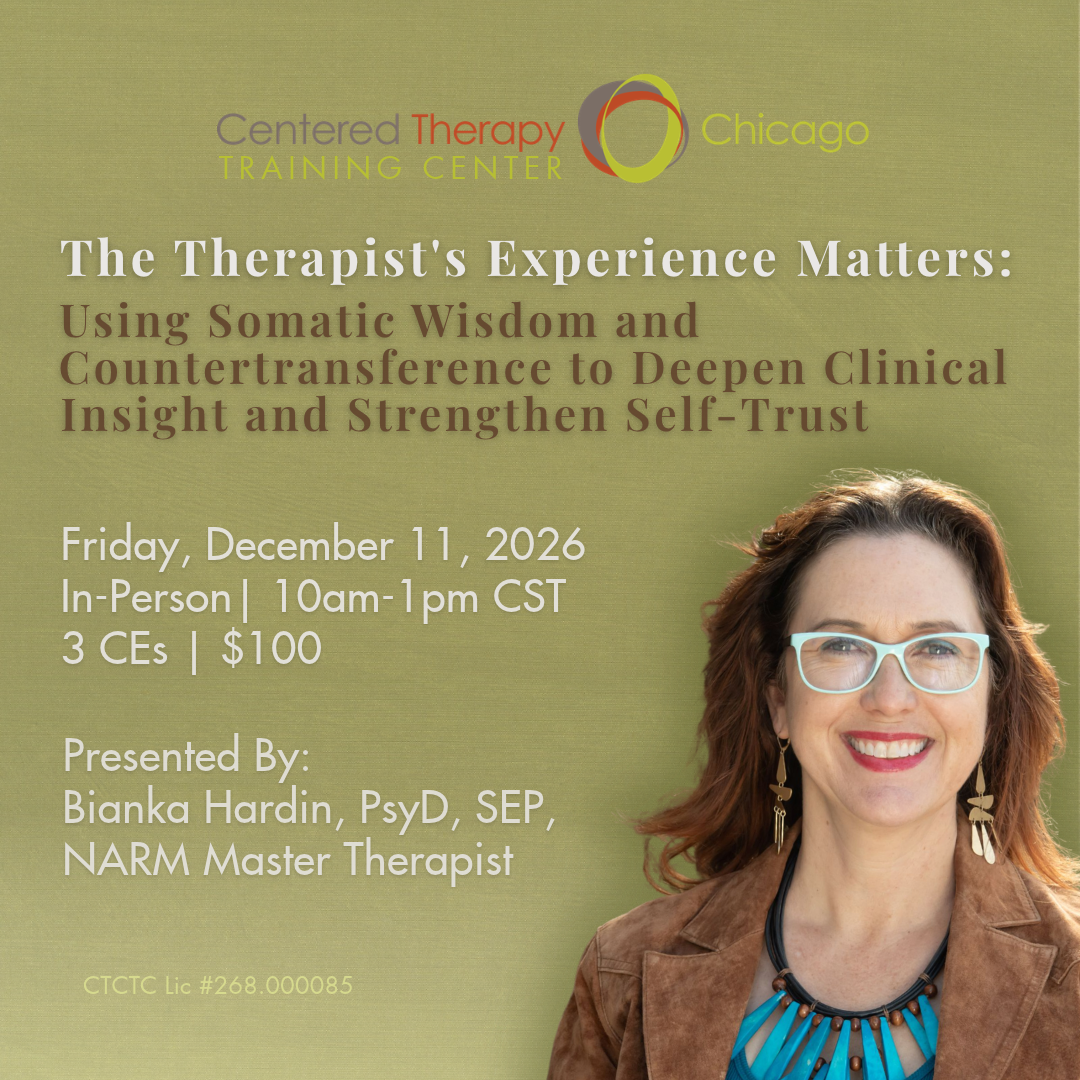
The Therapist’s Experience Matters: Using Somatic Wisdom and Countertransference to Deepen Clinical Insight and Strengthen Self-Trust Friday, December 11, 2026
The Therapist’s Experience Matters: Using Somatic Wisdom and Countertransference to Deepen Clinical Insight and Strengthen Self-Trust
An in-person workshop presented by Bianka Hardin, PsyD, SEP, NARM Master Therapist.
When Therapeutic Work Evokes Strong Reactions
Every therapist encounters clients who evoke strong reactions: frustration, helplessness, urgency, protectiveness, self-doubt, confusion, exhaustion, or even dread. While these responses can feel uncomfortable or lead therapists to question their effectiveness, they often contain valuable information about ourselves, our clients, and the therapeutic relationship.
The Challenges We Often Carry Alone
It is common for therapists to privately struggle with moments of self-doubt, uncertainty, or “imposter syndrome,” particularly when working with complex clinical dynamics. Strong emotional reactions, therapeutic impasses, and questions about our effectiveness are a natural part of clinical work, yet many clinicians carry these experiences alone. The silence surrounding these challenges can contribute to feelings of isolation, self-criticism, and disconnection from our own sense of competence and wisdom.
Yet what if these experiences are not signs of inadequacy, but meaningful and expected aspects of relational therapeutic work? And what if bringing them into a supportive learning community could foster greater connection, self-understanding, clinical insight, and confidence?
Finding Meaning in Countertransference
This highly interactive and experiential workshop explores countertransference through a somatic and relational trauma-informed lens. Rather than focusing solely on conceptual understanding, participants will engage directly with the challenges that arise in their own clinical work. Clinicians will be invited to bring examples of difficult therapeutic moments, stuck points, and countertransference reactions into a supportive learning space, where they will explore these experiences through individual reflection, small-group discussion, experiential exercises, and larger group consultation.
A Supportive Space for Reflection, Consultation, and Growth
In this workshop, participants will be invited to reflect, explore, and learn about their countertransference in real time. To protect client confidentiality, participants will focus primarily on their own emotional, relational, and somatic responses rather than detailed discussion of client-specific information. Through experiential consultation and collaborative inquiry, therapists will deepen their understanding of their responses, discover new perspectives, and uncover possibilities for more effective therapeutic engagement.
Understanding the Therapist’s Internal Experience
Through guided self-reflection, somatic practices, experiential learning, and collaborative exploration, participants will develop greater awareness of how their emotional, relational, and physiological responses can serve as valuable sources of clinical information. Together, we will examine how countertransference is shaped not only by the client and clinical situation, but also by the therapist’s own history, survival strategies, relational patterns, and nervous system responses.
Moving From Self-Criticism to Curiosity and Self-Compassion
We will focus on ways challenging therapeutic encounters can evoke self-criticism, uncertainty, and imposter syndrome. Participants will practice approaching these experiences with openness, curiosity, somatic awareness, and self-compassion to support professional growth, deeper therapeutic presence, and increased confidence in one’s clinical work.
Strengthening Presence, Confidence, and Clinical Insight
Rather than striving to eliminate countertransference, participants will learn how to recognize, understand, and thoughtfully utilize their responses in ways that enhance therapeutic effectiveness while strengthening trust in themselves as clinicians.
Who Should Attend
Appropriate for therapists at all levels of experience, this workshop is particularly relevant for clinicians interested in relational, psychodynamic, attachment-based, experiential, and somatic approaches to psychotherapy.
Learning Objectives
- Upon completion of this workshop, participants will be able to:
- Recognize and name countertransference reactions that emerge within challenging therapeutic relationships.
- Identify emotional, relational, and somatic cues that provide information about their internal experience and the therapeutic relationship.
- Explore therapist reactions through a somatic and relational trauma-informed lens that emphasizes curiosity, self-compassion, and reflection over self-judgment.
- Differentiate personal, client, and relational influences that contribute to countertransference responses and therapeutic impasses.
- Utilize experiential reflection, consultation, and collaborative inquiry to deepen understanding of challenging clinical encounters while maintaining appropriate client confidentiality.
- Apply countertransference awareness as a source of clinical insight to inform case conceptualization, therapeutic presence, and intervention choices.
- Cultivate greater self-trust and clinical confidence by recognizing countertransference, uncertainty, and self-doubt as common aspects of therapeutic work that can be explored through reflection, consultation, and professional support.
Presenter Bio:
Dr. Bianka Hardin is a Licensed Clinical Psychologist and the owner of Centered Therapy Chicago, PLLC. Since founding her group practice in 2014, she has remained dedicated to supporting children, adolescents, adults, and families in cultivating mental and emotional well‑being. With nearly 25 years of clinical experience as a trauma therapist, Dr. Hardin brings a deep commitment to lifelong learning, self‑reflection, and continued professional growth—values that ground her work as both a practitioner and a supervisor.
Dr. Hardin is a trauma‑informed, body‑oriented therapist and a Somatic Experiencing Practitioner (SEP) as well as a NARM Master Therapist. She has been deeply involved in both the Somatic Experiencing,® NARM Training Institute, and The Complex Trauma Training Center Training Communities as a Training Assistant and was a member of the Complex Trauma Training Center Leadership Teaching Assistant Team. Her integrative, body‑based, relational orientation informs her supervision framework, which supports clinicians in deepening their capacity for presence, regulation, and attuned therapeutic connection.
Dr. Hardin’s clinical passion centers on understanding trauma through a relational, cultural, systemic, and intergenerational lens. She has extensive experience working with trauma survivors as well as professionals in the healing arts, and she is particularly dedicated to supporting therapists navigating burnout, vicarious trauma, and the complex demands of contemporary clinical practice. Her work is anchored in the belief that healing takes place within relationships that honor the body, the nervous system, and the unique lived experiences each person carries.
A dedicated educator, Dr. Hardin has served in multiple academic leadership roles, including Full-Time and Part-Time Professor and Associate Department Chair at The Chicago School of Professional Psychology. She has supervised developing clinicians for more than two decades, beginning during her tenure as Assistant Director and later Director at the Village of Hoffman Estates Department of Health and Human Services. She has also supervised doctoral interns at Pillars Community Health. These experiences have shaped her supervision style, which emphasizes attunement, curiosity, embodiment, and the development of clinical intuition.
At Centered Therapy Chicago, Dr. Hardin has intentionally cultivated a culture of learning, growth, and trauma‑informed practice. Through the CTC Training Center and their pre‑doctoral training program, she provides supervision, consultation, and training on trauma, embodiment, self‑care, mindfulness, trauma stewardship, and relational approaches to healing. She frequently presents on trauma‑related topics and is known for her warm, grounded, and integrative teaching style.